Implementing AI is easy. Architecting knowledge is not.
Rolling out a copilot or an assistant is now a matter of weeks, sometimes days. What is much harder, and much less visible in a demo, is building the knowledge layer that makes those tools reliable. Managing that knowledge continuously, so it stays trustworthy as agents start acting on it, is harder still.
Skip that step, and this is what typically follows:
- More searches through fragmented archives without usable context
- More answers built on outdated or missing metadata
- More automation of the wrong answer
- More search results nobody trusts
- More output with no institutional knowledge underneath it
That is not knowledge transformation. That is digitising the chaos. It is not an AI strategy, it is another technology layer on top of spaghetti.
(continue reading below)
Trust is built in the architecture, not the model
A model can only be as reliable as the knowledge it draws on. Before AI can create value, organisations need clarity on what knowledge foundation actually needs to be in place. A few distinctions help structure that conversation:
- Data at rest vs. data in motion: what knowledge sits stored, and what needs to actively flow into proposals, delivery, onboarding and decision making?
- Foundational knowledge vs. derived knowledge: what is the base layer, and what is interpretation, synthesis or advice built on top of it?
- Public knowledge vs. proprietary IP: what does the chosen LLM already know, and where does your unique value actually begin?
- Documents vs. context: what is written in the file, and what meaning lives in project history, decisions and timing?
- Vector search vs. knowledge graph: is semantic search enough, or do relationships between clients, cases, methodologies and experts need to be modelled explicitly?
- Consolidate vs. clean up: what should be brought together, what should disappear, what is duplicate or outdated?
- Automation vs. governance: where can AI act independently, and where does it need a human in the loop?
These are not technical afterthoughts. They determine whether AI output can be trusted, adopted and sustained.
A modern take on VETRO
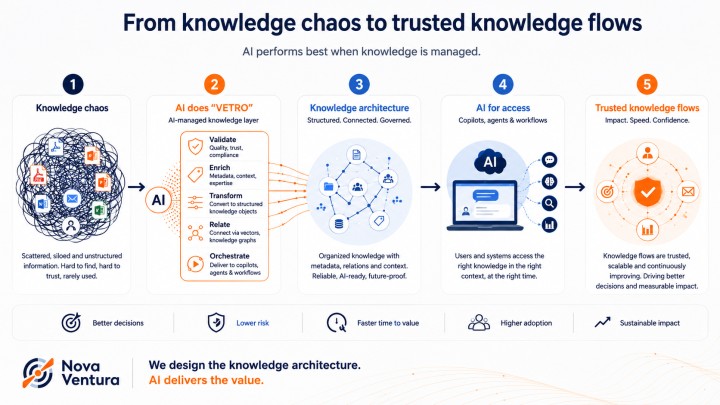
We use a modern take on VETRO to structure AI-driven knowledge architecture:
- Validate: is the source reliable, current, permitted and of sufficient quality?
- Enrich: what metadata, entities, context and expertise need to be added?
- Transform: how do slides, notes, transcripts and documents become AI-usable knowledge objects?
- Relate: how do those objects connect through vector databases, semantic layers and knowledge graphs?
- Orchestrate: how does that knowledge get delivered, in a controlled way, into copilots, agents and workflows?
The essence is not dumping everything into a chatbot. It is designing knowledge flows that can feed AI, bound it and keep improving it. Foundations before scale. Value before volume.
Our AI & Data related services
At Nova Ventura, we help you move AI into the core of your organisation, where it transforms decision-making, operations, products and strategy.
