
What does the new IT organization look like?
IT organisations have been evolving in waves for decades. From classic IT operations and waterfall delivery to agile, DevOps, the product model, and now AI-native IT, each wave has introduced a new way of organising technology, value creation, and decision-making.
When you zoom out, a clear pattern emerges. IT Ops was centred on control and stability. Waterfall brought predictability and governance. Agile shifted the focus to adaptability and iteration. DevOps accelerated flow and automation. The product model strengthened value creation and end-to-end ownership. Today, AI-native IT introduces a new frontier: scalable autonomy and self-optimisation.
Over time, the centre of gravity has clearly shifted. From 1970 to roughly 2010, control and predictability dominated. Between 2005 and 2022, the focus moved towards flow and speed. Since 2023, the next wave has been taking shape: autonomy.
(continue reading below the image)
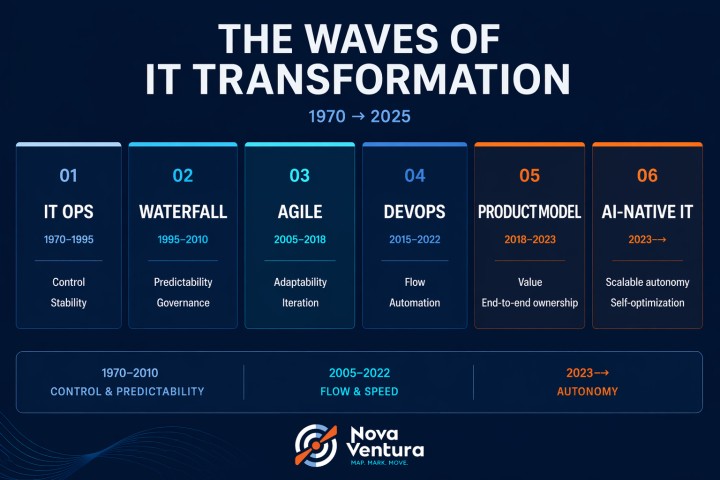
An automated IT5.0 or is it IT6.0?
That does not mean earlier models disappear. In practice, these waves tend to stack rather than replace one another. Waterfall and upfront design remain essential in regulated environments. Agile continues to power adaptable teams. DevOps remains critical for scalability and reliability. The product model anchors ownership and value creation. AI does not replace these foundations. It builds on them and amplifies them.
That is precisely where the real challenge begins. AI and hyperautomation do not improve organisations by default. They reinforce what is already there. A well-designed organisation becomes exponentially more powerful. An incoherent organisation becomes exponentially more complex.
So perhaps the real question today is not how quickly AI can be implemented. The more important question is whether the IT organisation is coherent enough to support autonomy.
The next wave in IT transformation is not just about adopting AI. It is about building an organisation that can carry autonomy with confidence. That requires coherence in operating model, governance, technology, and ownership. The organisations that get this right will not just use AI more effectively. They will be better prepared for what comes next.
