Keep, improve, start, stop.
Reduce, improve, delete, maintain.
When organizations scale artificial intelligence, two simple lenses often make the difference between progress and complexity:
- KISS: What will we Keep. Improve. Start. Stop.
>> KISS helps evaluate flow and ways of working.
- RIDM: What will we Reduce. Improve. Delete. Maintain.
>> RIDM forces structural clarity and architectural discipline.
These questions may appear simple. Yet they are highly relevant in today’s AI acceleration phase. Because while many companies are actively adding AI capabilities, fewer are deliberately simplifying their landscape at the same time. AI should not only be about adding capability. It should equally be about disciplined simplification. This is where KISS and RIDM become powerful. Together, they encourage leaders to balance innovation with rationalization.
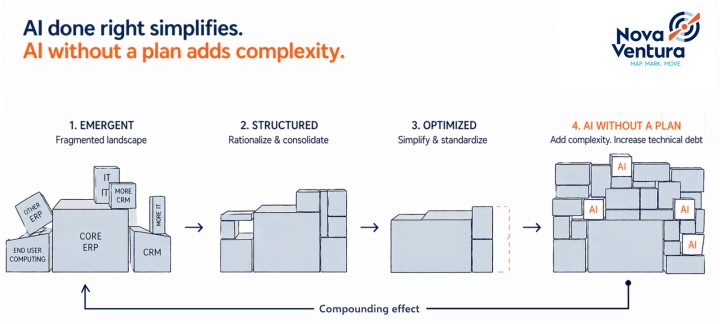
AI done right simplifies. AI without a plan adds complexity.
Artificial intelligence is rapidly moving from experimentation to enterprise-wide deployment. New tools, copilots, automation layers and analytics engines are being introduced across IT landscapes. Adding AI capabilities is relatively straightforward. Simplifying architecture is harder. Deciding to stop building what is no longer needed is harder still. AI becomes mature when it makes components redundant. When it consolidates. When it removes friction.
If AI initiatives primarily lead to:
- additional layers
- new tools and vendors
- extra integrations
- parallel solutions
- additional governance structures
the result is not transformation, but expansion. Expansion without rationalization typically increases structural complexity instead of reducing it.
(continue reading below the image)
The overlooked discussion: total cost of ownership
In the urgency to demonstrate AI activity, the broader total cost of ownership discussion is often sidelined. Total cost of ownership extends beyond licensing fees. It includes:
- integration and architectural impact
- cybersecurity and compliance requirements
- change and adoption efforts
- governance structures
- maintenance and lifecycle management
- accumulated technical debt
Without a lifecycle perspective, AI investments risk compounding long-term financial and operational burdens.
The market knowledge gap
Another structural challenge lies in market insight. Many organizations struggle to:
- assess solution maturity accurately
- distinguish between differentiating capabilities and emerging commodities
- determine what should be built internally versus adopted from the market
This can result in internal development of capabilities that become standardized within months, while existing fragmentation remains unresolved. Such patterns do not create sustainable advantage. They increase technical and organizational debt in real time.
The strategic questions leaders should ask
Before scaling AI further, organizations should reflect on:
- Which complexity are we adding, and what is the systemic impact?
- Which complexity are we actively removing?
- What is the total cost of ownership over a three-year horizon?
- What capabilities are truly strategic and differentiating?
- What initiatives risk becoming AI window dressing?
AI should function as a lever for simplification, integration and structural clarity.
Without market insight and a deliberate rationalization plan, AI risks accelerating fragmentation rather than resolving it.
Our AI & Data related services
At Nova Ventura, we help you move AI into the core of your organisation, where it transforms decision-making, operations, products and strategy.
