
The workforce reality behind AI and software products
Everyone can build, but not everyone should. The rise of tools like Lovable, Claude Design and the broader wave of vibe-coding and AI-assisted (or AI only) development has sparked a powerful narrative. The idea that everyone can build software is no longer hypothetical. It is already happening.
Across organizations, prototypes and lightweight applications are created faster than ever. What used to take weeks can now be done in hours. The excitement is real and justified. But behind that momentum, two structural realities are often overlooked.
1. Not everyone can or should be a pioneer
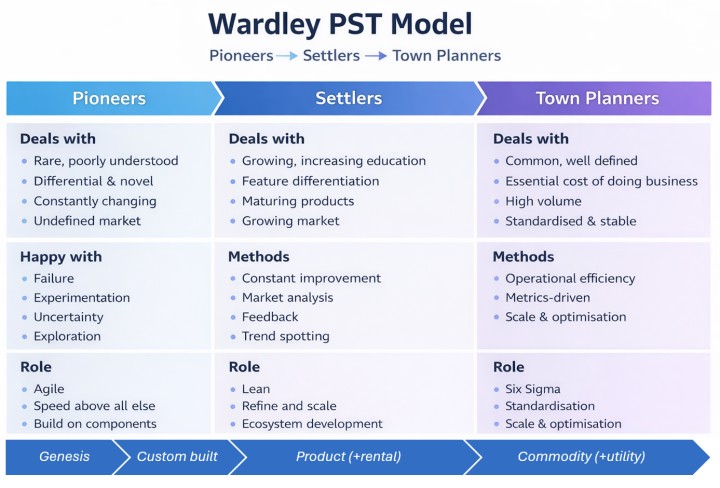
More than a decade ago, Simon Wardley described how innovation evolves through the PST model: pioneers, settlers and town planners.
- Pioneers explore what is possible.
- Settlers turn ideas into usable products.
- Town planners make those products scalable, reliable and manageable.
This distinction becomes critical when AI is used to build software products.
AI has dramatically lowered the barrier to creating prototypes and even running fully functional long-living applications. But building something that works is not the same as building a product that can be adopted, trusted and sustained within an organization. Between a first idea and a real stable software product lies a long chain. Solutions need to become understandable, usable, integrated, secure and maintainable. They need ownership, lifecycle management and alignment with existing systems. Each step requires a different mindset, a different skill set and a different operating model.
If everyone focuses on exploration, organizations risk ending up with a portfolio of disconnected tools and applications, rather than a coherent product landscape. AI does not remove the need for product thinking. It makes the gap between "I have an idea" all the way to building, scaling and improving much more visible.
(continue reading below the image)
2. Trust and accountability are not optional
Generating a prototype or internal tool is one thing. Running critical processes or products on it is something else entirely. AI will drive an explosion of proofs of concept, pilots and internally built applications. The boundary with shadow IT will blur. At the same time, the risk profile increases, especially around security, compliance and continuity. A working application does not automatically qualify as a reliable enterprise grade, let alone business critical product.
Before something becomes part of the core product or application landscape, key questions need to be answered.
- Who owns the product.
- Who maintains it as usage grows.
- Who validates outputs and ensures quality.
- How knowledge is transferred.
- Who guarantees security, continuity and compliance.
These are not technical afterthoughts. They are fundamental to whether something can operate as a product within an organization. Trust is not created at the moment of a successful build. It is established over time, as solutions prove to be reliable, secure and maintainable in real-world use.
From building to productizing
The future is not everyone becoming a developer. The future is that everyone can initiate and build. But value is only created when those builds are turned into real products that can be adopted and sustained. This requires a deliberate approach to workforce design and product ownership. Organizations need a balance between pioneers, settlers and town planners, aligned with the different stages of the product lifecycle. Even if we move faster troughout the cycle.
The real differentiator will not be how many tools or applications are created. It will be how effectively organizations turn them into scalable, integrated and trusted software products. That is where sustainable value is built.
Our AI & Data related services
At Nova Ventura, we help you move AI into the core of your organisation, where it transforms decision-making, operations, products and strategy.
